Yerevan, December 21, 2020
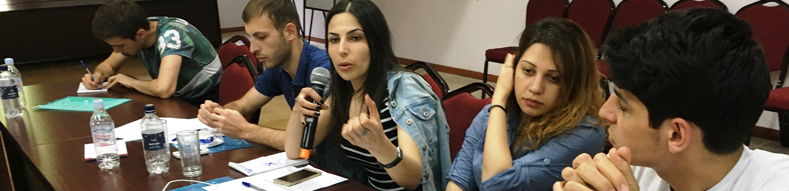
On December 18, an independent public meeting titled “Anti-Crisis Civil Discussion” was held in Yerevan and was attended by individual citizens, representatives of non-governmental organizations, and experts in the political, diplomatic, military, and scientific spheres. The goal of the meeting was to assess the crisis situation in post-war Armenia, clarify the directions for urgent steps, and develop practical recommendations.
Those present emphasized that since the end of the war, Armenia has found itself in a multi-layered crisis situation, which is facilitated by, on the one hand:
– the large-scale humanitarian problems caused by the war,
– the uncertainty of the fate of our missing and captured compatriots,
– the unprecedented, hast,y and careless process of demarcation of the borders of Armenia and Artsakh,
– the insufficient level of Armenia’s foreign policy and state, parliamentary, and public diplomacy,
– the weakening of Armenia’s positions in relations with the countries of the region,
– the difficult situation in the economic and healthcare sectors that has arisen since the coronavirus epidemic and intensified by the war, on the other hand:
– the passive attitude of the leadership of the Republic of Armenia, the lack of political will and the will to involve qualified specialists enjoying public trust in resolving the country’s security issues, establishing sovereignty and an effective state, implementing democratic, especially judicial and legal reforms, and overcoming the challenges facing the country,
– “17 The calls for violence voiced by the “political parties”, the spread of hate speech and street struggles accompanied by ultimatums on behalf of the entire society,
– as a result, the deepening polarization of society, the targeting of civil society by one pole, and the alienation by the other pole.
The participants in the discussion noted that the results of the war have hit the identity of the people of Armenia and Artsakh, the security and rights of the people, the state sovereignty and democracy of the Republic of Armenia, and the Republic of Nagorno-Karabakh are at risk. The post-war situation renders the guarantees of the people of Artsakh vulnerable to living in dignity in their historical homeland, to self-determination, and to the protection of their security and rights, and creates new challenges for the process of international recognition of the Republic of Artsakh.
During the war and in the post-war situation, the activities of the main responsible state structures of the Republic of Armenia have provoked a fair public outcry, creating an organizational and information vacuum, under which a number of state functions, including the coordination of logistics and the organization of humanitarian assistance, have been partially implemented and are being implemented through civic initiatives. Since 2018, the governing force, which has been acting on behalf of the people, today operates in the absence of direct communication with citizens and accountability.
The unclear status of Armenia’s representation in the ongoing negotiations, the uncertainty surrounding the country’s borders, the hasty unilateral implementation of the demarcation without creating guarantees for the safety of citizens, including residents of Artsakh and the border areas of Armenia, servicemen and volunteers, show that the government does not have sufficient professional resources and capabilities to implement the most important anti-crisis, security and defense functions, as well as the willingness to involve and cooperate with experts and representatives of the professional community.
The involvement of new forces in the governance of the Republic of Armenia has become imperative to ensure the continuity of the country’s statehood and the dignified life of its citizens. At the same time, it should be emphasized that any process aimed at the resignation of the government, which should be immediately followed by early parliamentary elections, must take place while maintaining the rule of law of the Republic of Armenia, within the framework of the Constitution and legislation of the Republic of Armenia.
In order to establish a healthy dialogue among the public, it is necessary to form a professional independent commission to investigate the substantive and factual circumstances of the failure to prevent, the course of, and the disastrous consequences of the war, which will allow to clear the field of endless mutual accusations, calm the heating up atmosphere of hatred, and hold the guilty accountable by force of law.
The participants of the meeting also emphasized that the current internal political tension results not only from the post-war crisis but also from the ruling power’s failure to uphold the public order of the democratic reforms of the 2018 Velvet Revolution and from strategic communication. In this regard, in order to resolve the crisis and stabilize the situation, first of all, it is necessary to give an impartial assessment of the path taken by all political forces responsible for the defeat in the Second Artsakh War, including recording:
– the destructive impact of the economic plunder and corrupt system implemented by the previous authorities for decades,
– The failed priority commitments of the current ruling power: the implementation of transitional justice, constitutional reforms, the adoption of a new electoral code, the law on political parties, reforms of the judicial system, increasing the resilience of the defense system, the absence of initiative and new approaches in diplomacy, and the economic revolution.
The following are essential for the implementation of anti-crisis steps:
– the adoption of the principles of excluding violence, protecting human rights and dignity,
– open, sincere, and multilateral dialogue as a way to find solutions,
– the adoption of the public solidarity agenda as a public demand and an opportunity to mobilize and consolidate the potential of society.
Based on the assessments and proposals made during the meeting, the initiative group will soon convene additional meetings, broaden the scope of discussion and like-minded participants, and take practical steps.
We hope that, in this way, we will foster an atmosphere of mutual trust and tolerance in society, where citizens will have a guaranteed opportunity to consistently implement their mandate to build a democratic and legal state. We are convinced that we cannot achieve external peace and development without internal reconciliation, genuine democracy, and dialogue.
The sovereignty of the Republic of Armenia has no alternative.
Participants
Arman Navasardyan, diplomat, lecturer, Slavonic University
Rafik Hakobyan, Dean of the Faculty of Physics, Yerevan State University
Gayane Shagoyan, Institute of Archaeology and Ethnography, NAS RA
Sosi Tatikyan, specialist in public, foreign, and security policy and management
Tamara Gevorgyan, “Center for Perspective Development”
Seda Muradyan, “Public Journalism Club” NGO
Liana Torosyan, “Democracy Today” NGO
Nina Karapetyants, “Helsinki Association” NGO
Zhanna Aleksanyan, “Journalists for Human Rights” NGO
Alexander Martirosyan, “Public Journalism Club”
Aramais Avetisyan, “Political Dialogue” NGO
Gohar Shahnazaryan, “Women’s Resource Center” NGO
Arman Gharibyan, “Force of Justice” NGO
Mamikon Hovsepyan, Pink Lawyers NGO
Arpi Manusyan, Socioscope NGO
Daniel Ioannisyan, ICM
Artashes Sergoyan, ICM
Anahit Simonyan, Human Rights Research Center
Davit Petrosyan, “Restart” Civic Initiative
Yuri Avagyan, “Restart” Civic Initiative
Meeting Initiator Team:
Karen Hakobyan, “Hope” NGO
Nune Sargsyan, Media Initiatives Center
Hovsep Khurshudyan, “Free Citizen” CISC NGO
Sona Ayvazyan, TIHC
Seda Grigoryan, RA Citizen
Lusine Kharatyan, RA Citizen