A roadmap proposed by civil society to overcome the crisis in Armenia
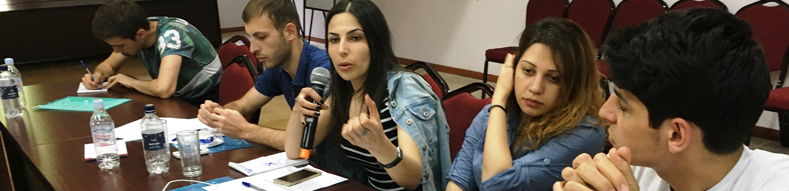
In addition to the meeting of civil society representatives held on December 18, 2020, during which an assessment of the situation in Armenia was provided, and a number of measures were proposed, a roadmap for resolving the crisis over the next 3-6 months was developed based on their summary.
Roadmap proposal for the period January 1 – March 31, 2021
In the period following the 44-day Artsakh war of 2020, all the forces and resources of the National Assembly and the Government of the Republic of Armenia, political forces and civil structures, as well as the Armenian Diaspora, should be concentrated on bringing the country out of the political, economic, social, humanitarian, and psychological crisis.
The measures outlined below should be implemented within the next 3 to 6 months, regardless of the electoral process. To coordinate them, it is necessary to establish an operational headquarters involving representatives of relevant structures, and to submit a public report on the results at least once a week, and more often if necessary. The initiative group expresses its willingness to form a circle of public oversight, to participate in the creation of separate working groups, and to be practically involved in their work. It is necessary to closely and daily cooperate with the public, scientific, research, local, and international structures and specialists operating in the relevant fields.
The roadmap for overcoming the crisis for the coming months should include at least the following directions and measures.
- Humanitarian issues
1.1. Prisoners of war and missing persons: Accelerate the search and return of prisoners of war and missing persons, and develop proposals for the earliest possible return of prisoners of war in the future. Initiate international legal proceedings regarding the torture of prisoners of war.
1.2 Social Security: Provide shelter and reasonable financial and other material support to homeless persons in Armenia and returning to Artsakh, ensuring that no one is left without shelter by the end of 2020, and without permanent shelter by the end of 2023. Develop a specialized concept, as needed, using innovative financial and construction approaches to ensure fast, efficient processes. Create opportunities for evacuees to work and engage in small businesses with privileged status (e.g., tax exemptions) to ensure their daily needs are met.
1.3. Psychological support: Ensure state funding and coordination to provide psychological support to war veterans and war victims, including by mobilizing relevant specialists and organizations.
1.4 Rehabilitation Program for the Disabled: Develop and adopt an action plan to organize the rehabilitation and protection of the rights of persons with disabilities as a result of the war.
1.5 Pandemic Management: Take measures to prevent and contain the spread of a potential new wave of the coronavirus, COVID-19, as well as the penetration of a new type of coronavirus.
- Defence and security
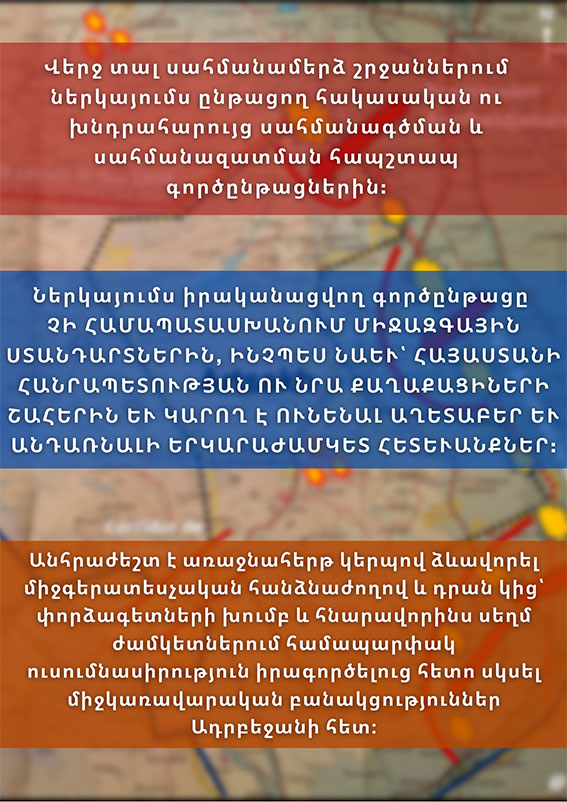
2.1 Border demarcation and delimitation (demarcation and delimitation): End the current hasty and controversial border demarcation and delimitation processes in the border regions. Regardless of how they are presented, whether as temporary or permanent, technical or legal solutions, the current process does not meet international standards, as well as the interests of the Republic of Armenia and its citizens, and may have disastrous and irreversible long-term consequences. Since the collapse of the Soviet Union, no formal demarcation and delimitation has ever been carried out, and the Soviet Union had only artificially drawn internal administrative-territorial borders, which in turn have been changed many times over the years. Taking these circumstances into account, the demarcation/border demarcation operations carried out since the end of the 44-day war should be viewed solely as a temporary situational solution to ensure a ceasefire, and their legal consolidation and recognition of borders, in the form of an oral statement or written document, should be excluded. It is necessary to form an interdepartmental commission and an expert group (lawyers, in particular, specialists in international law and human rights, historians, geographers, surveyors, cartographers, economists, demographers, military analysts, diplomats, hydrologists, etc.) as a matter of priority and, after conducting a comprehensive study in the shortest possible time, begin intergovernmental negotiations with Azerbaijan, if necessary, through the mediation of international, for example, representatives of the Minsk Group co-chair countries, to clarify the borders between the states, taking into account international experience and standards. [1]
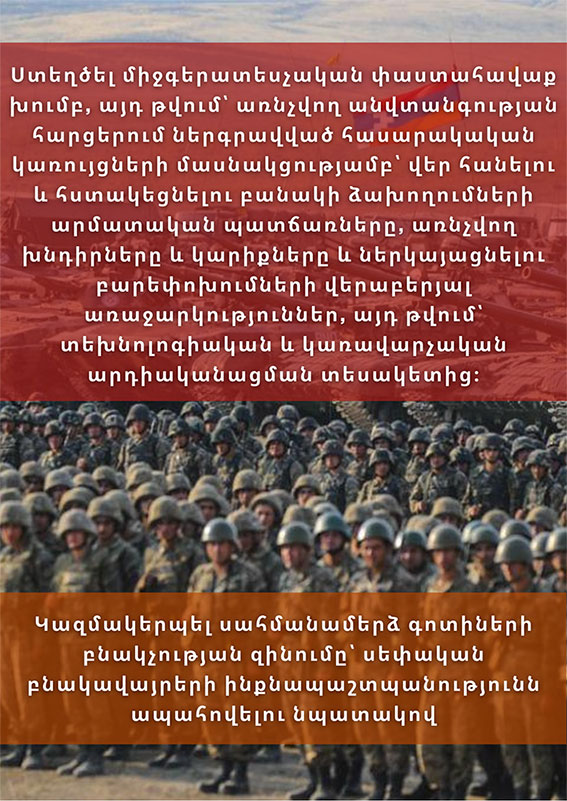
2.2 Army: To create an interdepartmental fact-finding group, including with the participation of public organizations involved in relevant security issues, to identify and clarify the root causes of the army’s failures, related problems and needs (before, during and after the war), including in terms of the state of weapons, technical equipment and infrastructure, the organization of the mobilization resource, ensuring proper conditions for servicemen in the army and their rights, and to present proposals for reforms, including from the point of view of technological and managerial modernization. Taking into account the current tension in the region, as well as the possible continuation of the conflict, to bring the army, as well as the mobilization resource, food and non-food, service conditions and human rights, armaments, the military industry, technical and infrastructure support to the proper level of readiness as soon as possible, to strengthen and re-equip the front line and to submit periodic reports on the process to the formed special working group.
2.3. World War II: Accelerate the formation and organizational work of the militia, introducing the most effective and efficient mechanisms possible, taking into account the experience of the last war, successful international models, and local characteristics. Organize the arming of the population of border zones in order to ensure the self-defense of their own settlements. Develop and implement mechanisms to ensure the employment of residents of border communities, including women, in defense and self-defense, including organizational and training support, and the provision of technical defense means.
2.4 Civil Defense: Taking into account the fact that many settlements have become border areas, as well as the generally low level of protection and awareness of the population of the Republic of Armenia, take urgent steps towards the implementation of the main civil protection measures prescribed by law, including ensuring the regulation of warning and rapid response systems, construction or rehabilitation of engineering defense structures and shelters, creation of necessary reserves of personal protection means for the population, preparation of public structures (e.g. medical institutions, educational institutions, community administrations) to bring them to a state of full readiness to be ready for all possible scenarios that may cause evacuation and have a complete mapping that actually assesses their resilience, strengthening the protection of important objects, informing and preparing the population on protection rules and measures, including ensuring high-quality awareness and acquisition of necessary skills in educational institutions.
2.5 Information security: Taking into account the propaganda and psychological operations carried out by external and internal forces through information warfare, the targeting and disruption of information systems during the war, the acquisition of information containing state secrets and personal data by the adversary, as well as the fact that the threat of disinformation within Armenia
- Diplomacy
3.1 Objective: In order to avoid further speculation, to officially and publicly clarify the official position and goals of the Republic of Armenia in the negotiations on the Artsakh issue, namely:
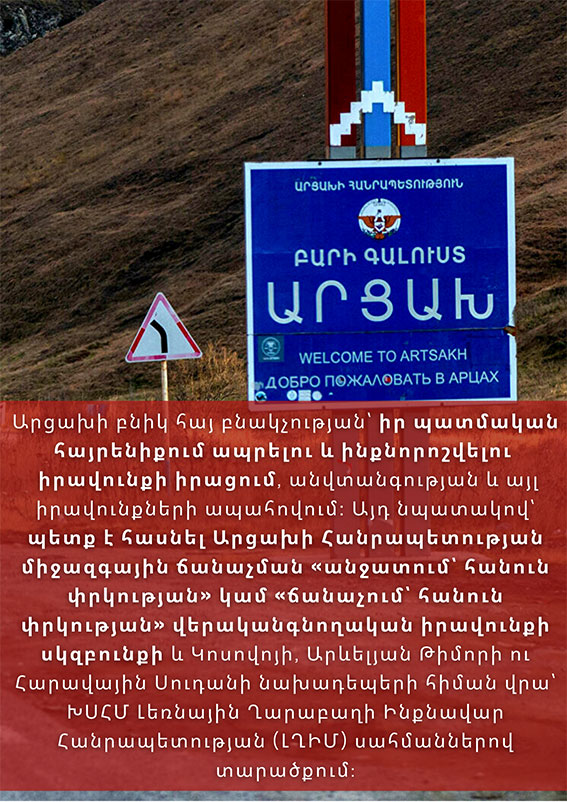
a/ people – the realization of the right of the indigenous Armenian population of Artsakh to live and self-determination in their historical homeland, ensuring security and other rights. To this end, it is necessary to achieve international recognition of the Republic of Artsakh on the basis of the principle of restorative law of “secession for the sake of salvation” or “recognition for the sake of salvation” and the precedents of Kosovo, East Timor and South Sudan, in the territory bordering the Nagorno-Karabakh Autonomous Republic (NKAR) of the USSR. To implement this principle, it will be necessary to create guarantees for the return of Armenian refugees to the Shahumyan region, Getashen, Martunashen and other Armenian settlements, for the return of Azerbaijani refugees to their former places of residence in Artsakh, including Shushi, to ensure a safe and uninterrupted corridor between Armenia and Artsakh, the free movement of RA citizens through this corridor and unhindered access to Artsakh and the security of the Artsakh population, with the participation of local defense forces, the support of the Armenian defense forces, and the participation of Russian and, if possible, neutral European peacekeepers.
b/ Monuments – creation of guarantees for the preservation of historical and cultural heritage in the territories under Azerbaijani control within the territory of the Nagorno-Karabakh Autonomous Region and beyond, including by considering the exchange of territories through demarcation and delimitation, the status subject to preservation and the preservation regime, including by ensuring security guarantees for visits.
c/ Water Resources – Deployment of peacekeeping forces in watershed areas, particularly in Armenia at the headwaters of the Vorotan and Arpa left tributaries, and in Artsakh at the headwaters of the Tartar, while simultaneously conducting negotiations so that, as a result of further official demarcation and demarcation, these territories will pass under the control of Armenia or Artsakh.
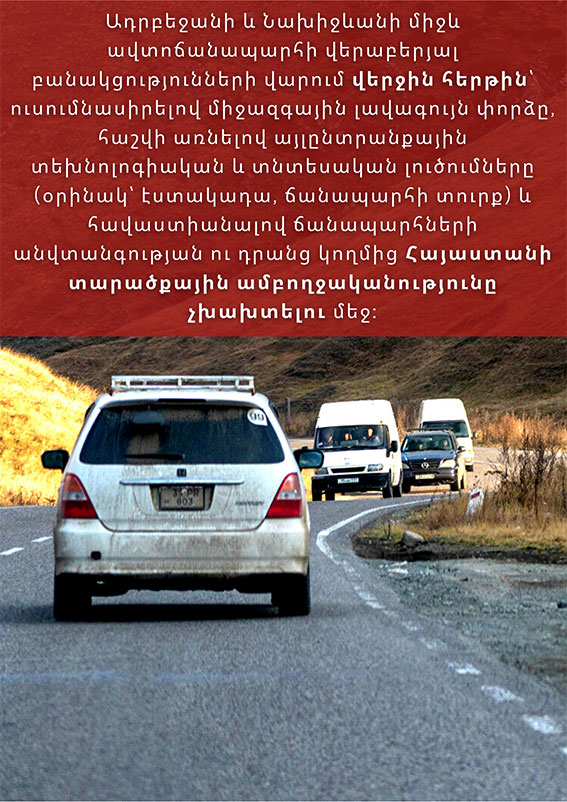
d/ Roads – Conducting negotiations on a highway between Azerbaijan and Nakhichevan, ultimately studying international best practices, taking into account alternative technological and economic solutions (e.g., overpass, toll road), and ensuring the safety of the roads and their non-violation of the territorial integrity of Armenia.
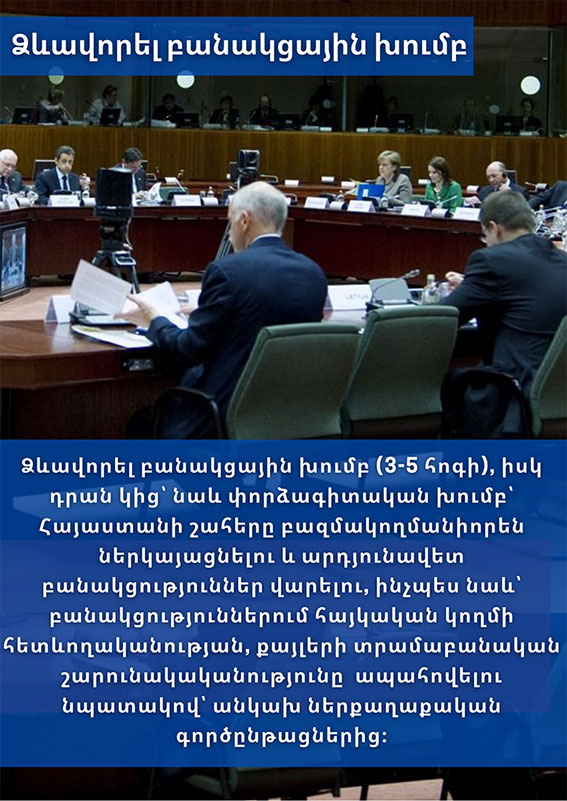
3.2 Conducting the negotiation process: To disclose to the public the entire content of the negotiations with Russia and Azerbaijan, including verbal agreements. Taking into account the key importance of the negotiation process from the perspective of ensuring the security of Armenia and Artsakh, the likelihood of the negotiations being long-term, the vulnerability of sole responsibility for their conduct, and the need to ensure stable, consistent, and effective work in the context of possible political changes after the upcoming elections, to form a negotiation group (3-5 people), and an expert group attached to it (involving experienced local and international diplomats, international law and security specialists, conflict analysts, specialists who have participated in conflict resolution processes, experienced in international organizations, historians, ethnographers, culturologists, monument experts, hydrologists) in order to comprehensively represent Armenia’s interests and conduct effective negotiations, as well as to ensure the consistency of the Armenian side in the negotiations and the logical continuity of steps, regardless of domestic political processes.
3.3 Ensuring the basis for effective negotiations: Ensure a proper investigation of war crimes and form a documentary and legal base that is as complete, professional, and in line with international trial standards as possible to present the positions of Armenia and Artsakh in international judicial and quasi-judicial bodies. Implement the entire legal toolkit provided for by international agreements, including intensive submission of applications and complaints to relevant international organizations (UN, OSCE, Council of Europe, EU, NATO, CIS, CSTO, if available, their parliamentary assemblies, etc.), judicial and quasi-judicial bodies of the UN, EU, and Council of Europe. Strengthen diplomatic representation in key international centers (Moscow, Washington, Paris, New York, Brussels, Strasbourg, Geneva, London, Beijing, Berlin, Delhi, Tbilisi, Tehran, Tel Aviv, Minsk, Rome, Stockholm, Cairo, Abu Dhabi, Latin America, Asia, Africa) and carry out extensive work on a solid foreign policy. Actively implement parliamentary diplomacy and coordinate public diplomacy, including by mobilizing organizations and individuals in Armenia and the Diaspora, as well as their institutional and personal connections.
3.4 Refugee Return: To create a commission (involving specialists in international law and humanitarian issues, historians, demographers, ethnographers, etc.) to study/correct the lists of Armenians displaced from the NKAO, Shahumyan region, Getashen, Martunashen and other adjacent Armenian settlements as a result of the two Artsakh wars and to understand their intentions, as well as the lists of Azerbaijanis and Azerbaijani settlements residing in the territory of the NKAO, in order to base their possible return to the Republic of Artsakh on correct principles and avoid speculation.
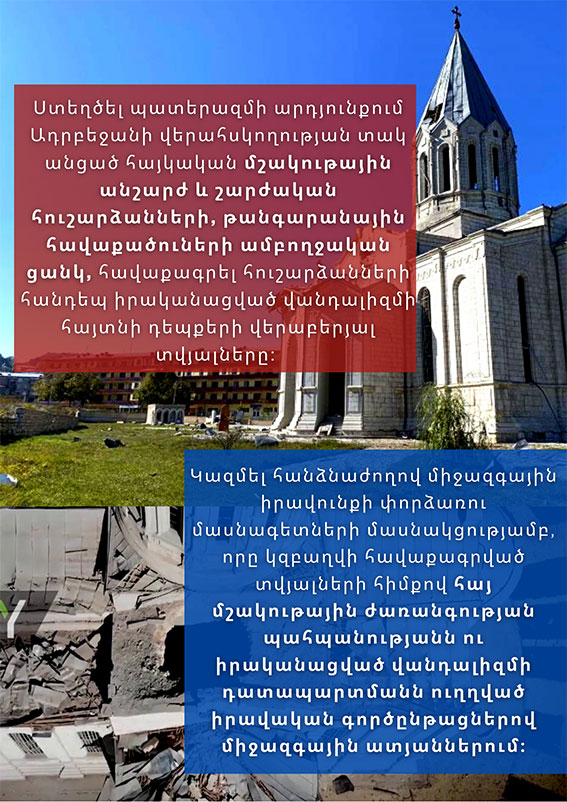
3.5 Preservation of cultural heritage: To create a complete list of Armenian cultural immovable and movable monuments and museum collections that came under the control of Azerbaijan as a result of the war, and to collect data on known cases of vandalism against monuments. To form a commission with the participation of experienced specialists in international law, which will engage in legal processes aimed at the preservation of Armenian cultural heritage and condemnation of the vandalism carried out on the basis of the collected data, addressing applications and complaints to reputable international cultural organizations and human rights protection bodies. To make special efforts to prevent the pro-Azerbaijani biased policy pursued by UNESCO, conditioned by the status of the First Lady and First Vice-President of Azerbaijan, Mehriban Aliyeva, as a UNESCO Goodwill Ambassador, and her use of appropriate leverage. To make efforts to create an independent international commission that will have a supervisory function and will monitor the condition of the monuments through periodic visits.
3.6 Peacekeeping: While highly appreciating the role of Russian peacekeeping forces in the cessation of hostilities and the establishment of peace in Nagorno-Karabakh, it is important to clarify the legal status, powers and responsibilities of the Russian peacekeeping mission, ensure the signature and ratification of the necessary legal documents by the authorities of Armenia and/or Artsakh, relations with the local population, accountability, issues related to the authorities of Armenia and Artsakh and civil society. It should be noted that since the ceasefire, such territories (Dizapayt, Khtsaberd, Hin Tagher) were handed over to Azerbaijan, which at the time of the ceasefire were under the control of the Artsakh Defense Army. The presence of peacekeepers did not exclude military operations on December 11-12, as a result of which the Armenian armed forces were attacked by the Azerbaijani armed forces, suffered casualties, injuries, and a significant number of new prisoners. However, it is important to ensure the safe return of the peaceful Armenian population to the NKAO, including settlements under the responsibility of Russian peacekeepers that border territories controlled by Azerbaijan, and to allow the Armenian population to enter Shushi and Hadrut to retrieve their property or exhibits left in museums. It is necessary to work through negotiations within the Minsk Group to supplement the peacekeeping mission with peacekeeping forces from other countries, in particular European neutral states, including their deployment in the 7 regions surrounding the NKAO, especially taking into account the plans to populate these territories with representatives of terrorist groups involved in the war. Taking advantage of the start of the OSCE Swedish Chairmanship, launch a new initiative to negotiate and establish a monitoring center in Artsakh representing the Minsk Group member states (except Turkey).
- Democracy
4.1 Rehabilitation of the political field: The involvement of new forces in the governance of the Republic of Armenia has become imperative in order to guarantee the continuity of the country’s statehood and the dignified life of citizens. At the same time, it should be emphasized that any process aimed at the resignation of the government, which should be immediately followed by early parliamentary elections, must take place with the observance of the rule of law of the Republic of Armenia, within the framework of the Constitution and legislation of the Republic of Armenia.
Taking into account the possibility of early elections, it is necessary to adopt amendments and supplements to the Electoral Code as soon as possible, in particular, to guarantee a fully proportional electoral system, transparency and public accountability of party and campaign financing, greater emphasis on party ideologies, proper disclosure and accountability of electoral violations.
4.2 Exclusion of electoral fraud: At least such measures should be taken in the direction of the judicial system that will promote the disclosure and condemnation of violations in electoral processes and will exclude electoral fraud.
4.3 Protection of civil society: Take measures to ensure the safety of human rights defenders, representatives of non-governmental organizations and foundations, and active public figures engaged in the protection of human rights and democratic values. Take steps to hold accountable individuals and groups involved in the deliberate targeting and persecution of organizations, their representatives, and individual public figures, and those spreading hate speech against them.
- Public solidarity
5.1 Restoring communication with the public: Launch all possible channels of communication between the NA and the government on the one hand and the Human Rights Defender, citizens, civil society and the expert community (including Artsakh Armenians and Diaspora Armenians) on the other: reception hours, meetings, participation in discussions, accountability events, briefings, joint work in working groups, RA NA standing committees, discussions in public/public councils, parliamentary hearings, etc. Put public television at the service of restoring public solidarity through special programs, including by providing a platform for state bodies to ensure accountability for the results of crisis management and to create and entrench a new culture that will turn real debate between the two sides into a political practice and gradually put an end to remote monologues and mutual accusations.
5.2 Disclosure of crimes: To reveal the vicious phenomena that occurred during the war, in particular, those that are often publicly labeled as “treason” by various forces, to complete the initiation of criminal cases and court proceedings, striving to ensure that the situation related to the defeat in the Artsakh war becomes more understandable to the public before the snap elections and that the pre-election campaign does not turn into campaigns by political forces to unnecessarily label each other as “traitors.”
[1] Delimitation and Demarcation of State Boundaries: Challenges and Solutions | OSCE (2017)